How to fix it
Work through these in order, the most common causes come first.
Start With the Basics
Wrong attachment selected: the single most common cause.
Continental Europe's Type C/E/F and the UK's Type G look distinct once you know what to check for, two round pins versus three rectangular pins, but they're easy to confuse under time pressure.
Recessed outlets: older buildings in parts of Europe and South America sometimes have outlets set unusually deep into the wall, which a bulky multi-port adapter's housing may not reach.
Worn or bent pins: repeated travel use can gradually bend plug pins just enough to prevent a firm seat, even with the correct attachment.
Diagnosing Your Specific Problem
Adapter won't insert at all: almost always the wrong plug attachment for that country's standard.
Recheck the outlet's p in pattern against your adapter's available heads.
Adapter inserts partway but won't seat fully: likely a recessed outlet or a housing too bulky for that specific wall fixture.
Try a slimmer adapter or attachment if available.
Adapter seats but feels loose or wiggles: check for p in wear or slight bending.
Our picks
Products we recommend
As an Amazon Associate I earn from qualifying purchases. Picks are based on manufacturer specs, independent reviews and owner reports.
OREI
Small enough to keep in a daypack pocket for daily sightseeing
- Slide-out plug attachments including Type C/E/F and Type G
- 2 USB-A ports plus 1 universal AC outlet
- Safety shutters and fuse protection
- Compact size
✓ Pros
- Small enough to keep in a daypack pocket for daily sightseeing
- Safety shutters block accidental contact with live pins
✕ Cons
- Only one AC outlet limits simultaneous device charging
- USB ports top out at 2A, slower than PD-equipped alternatives
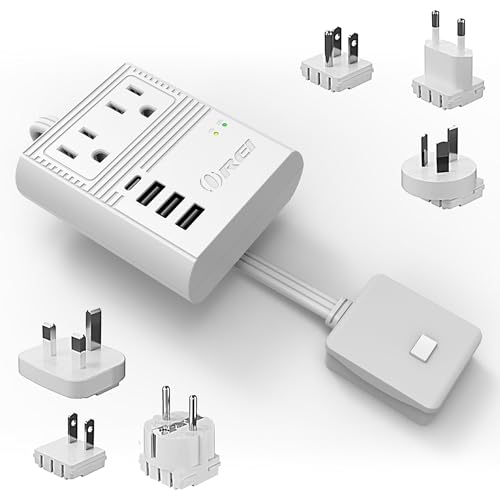
OREI
Six total charging points from a single European hotel outlet
- Interchangeable plug heads for Europe and the UK
- 2 USA outlets, 3 USB-A ports, 1 USB-C PD 18W port
- Grounded 3-prong design
✓ Pros
- Six total charging points from a single European hotel outlet
- 18W USB-C PD charges a phone noticeably faster than USB-A-only kits
- Grounded design adds safety marg in for laptop chargers
✕ Cons
- Larger and heavier than a simple plug-only adapter
- 18W PD is not enough to fast-charge most laptops
BESTEK
Genuine step-down voltage conversion, not just a plug shape adapter, matters for single-voltage hair tools
- 100-220V to 110V step-down voltage conversion, 250W
- 6A 4-port USB charging
- 3 AC sockets
- EU/UK/AU/US/India plug attachments
- Covers 150+ countries
✓ Pros
- Genuine step-down voltage conversion, not just a plug shape adapter, matters for single-voltage hair tools
- Three AC sockets plus four USB ports cover a full family's devices from one wall plug
- Wide plug attachment set covers most common destinations
✕ Cons
- 250W ceiling means it cannot run high-draw appliances like full-size hair dryers
- Bulkier and heavier than plug-only adapters since it houses conversion electronics
- Audible fan noise reported by some owners during conversion
FAQ
Common questions
Why won't my universal travel adapter fit a European outlet?
The most common cause is having the wrong attachment head selected or attached. Continental Europe uses Type C/E/F (two round pins), which is visually distinct from Type G (UK, three rectangular pins). Double check you've slid or clicked in the correct head for your specific country before assuming the adapter itself is defective.
Can a travel adapter be too big for a recessed outlet?
Some older buildings, particularly in parts of Europe and South America, have deeply recessed wall outlets that a bulky universal adapter's housing can't reach into far enough to make contact, even though the p in shape is correct. This is a known limitation of larger multi-port adapters and is less common with slimmer single-purpose adapters.
Is it safe to force a travel adapter into an outlet that doesn't quite fit?
If a plug doesn't seat naturally and requires noticeable force, stop. Forcing it risks bending pins, damaging the outlet, or creating a loose connection that can arc or overheat. Check for the correct attachment first, and if the outlet is simply incompatible, don't force a fit.
Keep researching
Related guides & comparisons