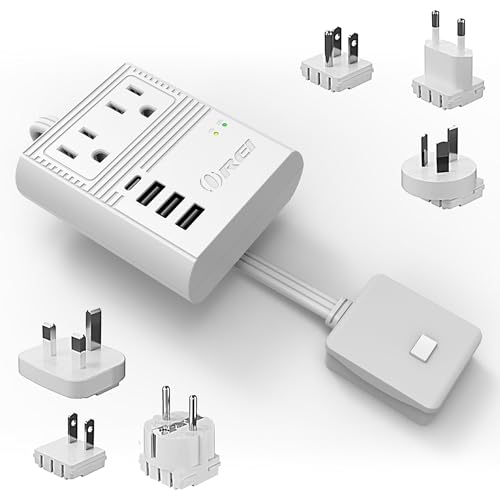
Start With the Plug Type
Look up your destination's plug standard before anything else.
A universal adapter with interchangeable heads covers multiple standards in one device, useful for any multi-country itinerary.
A single-plug adapter is lighter and often cheaper but only works for that one standard.
Voltage Conversion Is a Separate Question From Plug Shape
This is the most commonly misunderstood part of buying a travel adapter.
A plug adapter changes the p in shape only.
It does nothing to the actual electrical current.
Most modern electronics are dual voltage and only need a plug adapter.
Single-voltage appliances, most commonly older hair tools, need a genuine voltage converter, a bulkier, heavier, and more expensive product category.
Match Port Count to How You Actually Travel
A solo traveler charging one phone overnight needs far less than a family sharing one hotel outlet across several devices.
Count your simultaneous charging needs honestly before paying for more ports than you'll use, or before buying something too limited for your actual trip.
Don't Skip Basic Safety Features
A built-in fuse and safety shutters over the pins are inexpensive for manufacturers to include and their absence, even on a cheap adapter, is a red flag.
Surge protection and grounded outlets are worthwhile upgrades, particularly if you're traveling with a laptop or other expensive electronics.
Our picks
Products we recommend
As an Amazon Associate I earn from qualifying purchases. Picks are based on manufacturer specs, independent reviews and owner reports.
OREI
Small enough to keep in a daypack pocket for daily sightseeing
- Slide-out plug attachments including Type C/E/F and Type G
- 2 USB-A ports plus 1 universal AC outlet
- Safety shutters and fuse protection
- Compact size
✓ Pros
- Small enough to keep in a daypack pocket for daily sightseeing
- Safety shutters block accidental contact with live pins
✕ Cons
- Only one AC outlet limits simultaneous device charging
- USB ports top out at 2A, slower than PD-equipped alternatives
OREI
Six total charging points from a single European hotel outlet
- Interchangeable plug heads for Europe and the UK
- 2 USA outlets, 3 USB-A ports, 1 USB-C PD 18W port
- Grounded 3-prong design
✓ Pros
- Six total charging points from a single European hotel outlet
- 18W USB-C PD charges a phone noticeably faster than USB-A-only kits
- Grounded design adds safety marg in for laptop chargers
✕ Cons
- Larger and heavier than a simple plug-only adapter
- 18W PD is not enough to fast-charge most laptops
BESTEK
Genuine step-down voltage conversion, not just a plug shape adapter, matters for single-voltage hair tools
- 100-220V to 110V step-down voltage conversion, 250W
- 6A 4-port USB charging
- 3 AC sockets
- EU/UK/AU/US/India plug attachments
- Covers 150+ countries
✓ Pros
- Genuine step-down voltage conversion, not just a plug shape adapter, matters for single-voltage hair tools
- Three AC sockets plus four USB ports cover a full family's devices from one wall plug
- Wide plug attachment set covers most common destinations
✕ Cons
- 250W ceiling means it cannot run high-draw appliances like full-size hair dryers
- Bulkier and heavier than plug-only adapters since it houses conversion electronics
- Audible fan noise reported by some owners during conversion
FAQ
Common questions
What's the single most important factor in choosing a travel adapter?
Your destination's plug type, followed closely by whether any device you're bringing needs actual voltage conversion rather than just a plug shape change. Everything else, port count, USB-C speed, surge protection, is a refinement on top of getting those two basics right.
Should I buy one universal adapter or a single-country adapter?
If your trip visits more than one plug standard, or if you travel internationally more than once every few years, a universal adapter with interchangeable heads is the better long-term value even at a similar or slightly higher price. A single-country adapter only makes sense if you know for certa in you'll only ever need that one plug type.
How do I know if I need a voltage converter instead of just a plug adapter?
Check the fine print on each device's charger brick. If it lists an input range like 100-240V, you only need a plug adapter. If it lists a single voltage like 120V only, common on older or lower-cost hair dryers, curling irons, and straighteners, you need an actual voltage converter, not just an adapter.
Keep researching
Related guides & comparisons