How to fix it
Work through these in order, the most common causes come first.
Start With the Installation Tilt
Nearly every window air conditioner needs to sit tilted slightly downward toward the outside, generally a quarter to half inch lower on the outdoor side than the indoor side.
This small angle is what lets gravity carry condensation to the dra in holes and out of the unit rather than pooling on the indoor side.
Use a level placed on top of the unit to check the current angle.
If it's level or tilted the wrong way, adjust the mounting rail, shims, or foam blocks underneath until the outside edge sits slightly lower.
Diagnosing Your Specific Leak Pattern
Water drips steadily from the bottom of the indoor side: most likely an installation tilt problem.
Recheck and correct the angle first.
Water appears only after the unit has been running for hours on a very humid day: likely a temporary condensation overload rather than a mechanical fault.
Monitor whether it resolves as outdoor humidity drops.
Water appears mainly when the unit is turned off or the compressor cycles down: often ice that built up on the coil during operation, now melting faster than the dra in system handles.
Our picks
Products we recommend
As an Amazon Associate I earn from qualifying purchases. Picks are based on manufacturer specs, independent reviews and owner reports.
Frigidaire
Frigidaire's slider/casement AC is shaped tall and narrow to fit windows that open sideways.
✓ Pros
- Designed for slider and casement windows
- Remote and 24-hour timer
- Washable filter
- Sleep mode
✕ Cons
- Heavy at about 68 lb
- Needs a minimum opening around 15.5 in wide
- Installation kit may need extra panels
Top pickGE Profile
8,300 BTU edges out the 8,000 BTU competitors here for genuinely large 300 to 350 sq ft rooms
- 8,300 BTU cooling capacity, the highest single-BTU figure here
- Cools rooms up to 350 sq ft
- Flex-depth frame fits 4.5 to nearly 14-inch-thick walls
- 41 dB rated operation
- SmartHQ Wi-Fi app, Alexa and Google Assistant
✓ Pros
- 8,300 BTU edges out the 8,000 BTU competitors here for genuinely large 300 to 350 sq ft rooms
- Low-profile frame keeps more window visible in a room w here the AC is on display all day
- 41 dB rating stays reasonable even during long afternoon and evening run times
- No mounting bracket simplifies a living room installation that's often a wider, heavier window
✕ Cons
- 8,300 BTU still tops out at 350 sq ft; a true open floor plan will need the 12,200 BTU version
- Flex-depth frame is bulkier to remove and store than a slim slide-in unit
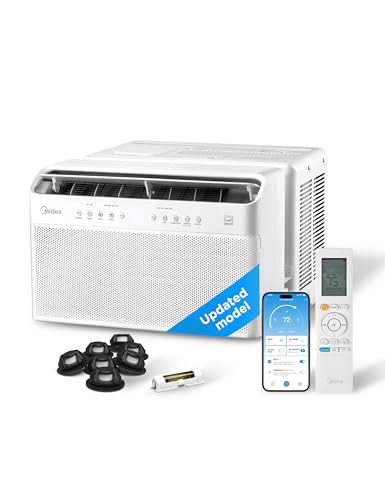
Midea
Inverter compressor uses less energy than a fixed-speed unit when it's running most of the day, which matters in a room people occupy from morning to night
- 8,000 BTU inverter compressor
- Cools rooms up to 350 sq ft
- 37% more efficient than the federal minimum standard
- U-shaped design routes noise outside the window
- Also sold in a 12,000 BTU version for larger open spaces
✓ Pros
- Inverter compressor uses less energy than a fixed-speed unit when it's running most of the day, which matters in a room people occupy from morning to night
- 37% efficiency ga in over the federal standard adds up over a full cooling season in a heavily used room
- Available in a 12,000 BTU U-shaped version for an open living-dining layout without switching brands
- Quietest running unit in this list during long stretches of continuous use
✕ Cons
- Installation across the window sash takes longer than a standard slide-in unit
- Midea's 2025 recall and repair program covers some early U-shaped units over a mold risk; verify status before buying used
- 8,000 BTU version is on the small side for a genuinely open-concept space
FAQ
Common questions
Why is my window air conditioner dripping water inside the room?
The most common cause is an installation tilt problem. Window units are designed to sit tilted slightly downward toward the outside, typically about a quarter to half inch lower on the outdoor side, so condensation drains outward rather than pooling and dripping back into the room. If the unit is level or tilted the wrong way, water collects on the indoor side and leaks in.
Is it normal for a window air conditioner to drip water outside?
Yes, this is normal and expected. Window units remove humidity from the room as part of the cooling process, and that moisture has to go somewhere. A properly installed unit drains this condensation out the back or bottom to the outside; the problem is only when water appears inside the room, not outside.
Can a dirty filter cause a window air conditioner to leak?
A clogged filter restricts airflow across the evaporator coil, which can cause the coil to get too cold and ice over. When that ice later melts, usually when the compressor cycles off or the unit is turned off, it can produce more water than the dra in system is designed to handle at once, leading to an overflow inside.
Should I stop using my window air conditioner if it's leaking?
It's worth turning it off and checking the installation tilt and dra in before continuing to run it, especially if water is reaching a windowsill, wall, or flooring that could be damaged. Most leaks are a straightforward installation or maintenance fix, not a sign the unit needs replacement.
Keep researching
Related guides & comparisons