Step 1: Confirm Your Window Type
Standard window air conditioners, including every model covered in this category, require a double-hung or single-hung sash window that raises vertically.
The unit's chassis slides into the opening created when you raise the sash, with extendable side panels sealing the remaining gaps.
If your window is a casement (crank-out), slider, or awning style, a standard unit will not install.
See our casement window guide for the real alternatives: a portable AC with a casement window kit, a through-the-wall unit, or a ductless mini-split.
Step 3: Decide How Much Noise Matters
For a bedroom, home office, or any room you occupy for long stretches, an inverter compressor is worth the added cost.
The Midea U-Shaped's 32 dBA low-fan rating and the GE Profile ClearView's 41 dB rating are both meaningfully quieter than a standard fixed-speed compressor unit like the LG LW8017ERSM1, which has no published low-noise rating.
For a room used occasionally, like a guest room or a garage workspace, the noise difference matters less, and a standard fixed-speed unit is a reasonable way to save money.
Our picks
Products we recommend
As an Amazon Associate I earn from qualifying purchases. Picks are based on manufacturer specs, independent reviews and owner reports.
Frigidaire
Frigidaire's slider/casement AC is shaped tall and narrow to fit windows that open sideways.
✓ Pros
- Designed for slider and casement windows
- Remote and 24-hour timer
- Washable filter
- Sleep mode
✕ Cons
- Heavy at about 68 lb
- Needs a minimum opening around 15.5 in wide
- Installation kit may need extra panels
Top pickGE Profile
8,300 BTU edges out the 8,000 BTU competitors here for genuinely large 300 to 350 sq ft rooms
- 8,300 BTU cooling capacity, the highest single-BTU figure here
- Cools rooms up to 350 sq ft
- Flex-depth frame fits 4.5 to nearly 14-inch-thick walls
- 41 dB rated operation
- SmartHQ Wi-Fi app, Alexa and Google Assistant
✓ Pros
- 8,300 BTU edges out the 8,000 BTU competitors here for genuinely large 300 to 350 sq ft rooms
- Low-profile frame keeps more window visible in a room w here the AC is on display all day
- 41 dB rating stays reasonable even during long afternoon and evening run times
- No mounting bracket simplifies a living room installation that's often a wider, heavier window
✕ Cons
- 8,300 BTU still tops out at 350 sq ft; a true open floor plan will need the 12,200 BTU version
- Flex-depth frame is bulkier to remove and store than a slim slide-in unit
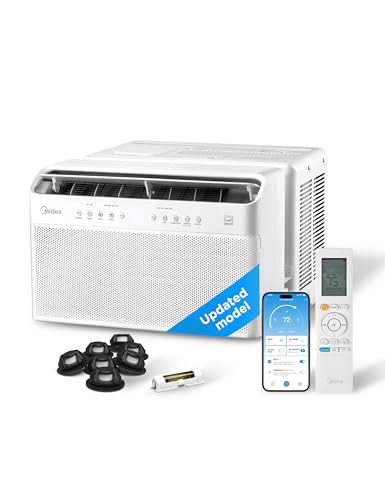
Midea
Inverter compressor uses less energy than a fixed-speed unit when it's running most of the day, which matters in a room people occupy from morning to night
- 8,000 BTU inverter compressor
- Cools rooms up to 350 sq ft
- 37% more efficient than the federal minimum standard
- U-shaped design routes noise outside the window
- Also sold in a 12,000 BTU version for larger open spaces
✓ Pros
- Inverter compressor uses less energy than a fixed-speed unit when it's running most of the day, which matters in a room people occupy from morning to night
- 37% efficiency ga in over the federal standard adds up over a full cooling season in a heavily used room
- Available in a 12,000 BTU U-shaped version for an open living-dining layout without switching brands
- Quietest running unit in this list during long stretches of continuous use
✕ Cons
- Installation across the window sash takes longer than a standard slide-in unit
- Midea's 2025 recall and repair program covers some early U-shaped units over a mold risk; verify status before buying used
- 8,000 BTU version is on the small side for a genuinely open-concept space
FAQ
Common questions
What's the first thing I should check before buying a window air conditioner?
Standard window air conditioners require a double-hung or single-hung sash window that slides up vertically. If you only have casement (crank-out), sliding, or awning windows, a standard unit will not install at all, and you need a portable AC with the appropriate window kit or a through-the-wall unit instead.
How do I know what BTU size I need?
As a rough guide: 150 sq ft needs about 5,000 BTU, 250 sq ft needs about 6,000 BTU, and 340 to 350 sq ft needs about 8,000 BTU. Add roughly 10% more capacity for a kitchen or a room that gets direct afternoon sun, and size up one tier for an open floor plan that connects to other rooms.
Is it worth paying more for an inverter compressor?
If the unit will run most of the day in an occupied room, like a bedroom or a living room, yes. Inverter compressors like the one in the Midea U-Shaped hold a steady, quiet output instead of cycling fully on and off, which saves on both noise and electricity over a full cooling season. For a room used only occasionally, the savings matter less.
Do I need a smart, Wi-Fi-connected window air conditioner?
Not for core functionality. Every unit in this category cools and dehumidifies the same whether or not it's connected to an app. Wi-Fi adds remote start, scheduling, and energy monitoring, genuinely useful conveniences but not something that changes the unit's cooling performance.
Keep researching
Related guides & comparisons