Start With How You Actually Sleep
Before comparing any specific pillows, be honest about your sleep position on a typical flight or car ride.
Upright and centered, leaning to one side, or reclined each favor a different pillow design, and this single factor eliminates more bad options than any spec sheet.
Match Packed Space to Your Trip Type
A pillow that costs you no carry-on space, like a dense memory foam horseshoe, is worth choosing when you're checking a bag anyway.
On a carry-on-only trip, a pillow that folds flat or deflates recovers real, usable bag space.
Decide If Anchoring Matters
A strap system is a genuine functional upgrade for deep sleepers, not a gimmick, but it only helps if your typical seat has the headrest wings it needs to attach to.
Check this before it becomes a deciding factor in your purchase.
Match Shape to Your Specific Complaint
Head falling forward with mouth open: a J-shaped chin-support design.
Sliding sideways against a window: a dense, tall-walled foam horseshoe.
No specific recurring complaint: a general-purpose horseshoe pillow is a safe, versatile default.
Our picks
Products we recommend
As an Amazon Associate I earn from qualifying purchases. Picks are based on manufacturer specs, independent reviews and owner reports.
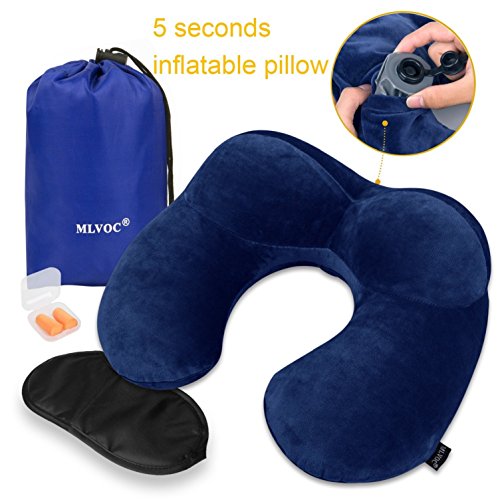
MLVOC
Its case rests on adjustable firmness lets you inflate it less for a smaller, softer fit on a child's neck and deflates flat to fit inside a kid's backpack alongside other travel items.
- Inflatable U-shape with adjustable firmness
- Soft micro-velvet cover
- Deflates flat for a backpack
- Includes eye mask and earplugs
- Typically priced under $25
✓ Pros
- Adjustable firmness lets you inflate it less for a smaller, softer fit on a child's neck
- Deflates flat to fit inside a kid's backpack alongside other travel items
- Soft velvet cover is gentler against a child's sk in than firmer foam
- Lowest price in the category, less to worry about if it gets left behind
✕ Cons
- Needs an adult or older child to inflate it before use
- Less durable long-term than a foam pillow for daily use
Cabeau
Works well once a child is close to adult neck size, typically early teens
- Dense memory foam horseshoe
- Seat strap system
- Quick-dry cover
- Compresses for a carry bag
✓ Pros
- Works well once a child is close to adult neck size, typically early teens
- Strap keeps the pillow anchored during a long flight, useful for a child sleeping deeply
- Same durable foam construction as the adult version
✕ Cons
- Too large and firm for most kids under about 10
- Priced higher than pillows built with kids' budgets in mind
Trtl
Very light and soft, comfortable for a child to wear for a full flight
- Scarf-style wrap with internal support plinth
- Weighs about 4.5 ounces
- Soft fleece exterior
- Machine washable
✓ Pros
- Very light and soft, comfortable for a child to wear for a full flight
- Wraps like a scarf rather than sitting like a stiff collar
- Packs small enough for a child's own backpack
✕ Cons
- One-size wrap can be loose on a smaller child's neck
- No back-of-head support if the child leans back to sleep
FAQ
Common questions
What's the single most important factor in choosing a travel neck pillow?
How you actually fall asleep, upright and centered, leaning to one side, or reclined. A pillow matched to your real sleep position outperforms a higher-rated pillow that's built for a different one. Someone who leans toward a window benefits most from a side-support design like the Cabeau Evolution S3 or J-Pillow, while someone who sits upright and centered may get just as much benefit from a lighter, cheaper option.
Should I prioritize packed size or support quality?
It depends on your trip. For a single flight with checked luggage, packed size barely matters and a bulkier, more supportive foam pillow is the better choice. For a carry-on-only trip or a multi-leg itinerary, a pillow that folds flat or deflates, like the Trtl or an inflatable design, is worth the tradeoff in raw support.
Is a seat strap system worth seeking out specifically?
If you tend to fall into deep sleep on flights, yes, a strap system like the Cabeau Evolution S3's is the only mechanism that keeps working once you're no longer consciously holding your own position. If you tend to doze lightly rather than sleep deeply, the benefit is smaller.
Keep researching
Related guides & comparisons