The One-Question Shortcut
What bread do you toast most often?
Just bagels, regularly: any model with a bagel mode and 1.25-inch minimum slots.
Our picks
Products we recommend
As an Amazon Associate I earn from qualifying purchases. Picks are based on manufacturer specs, independent reviews and owner reports.
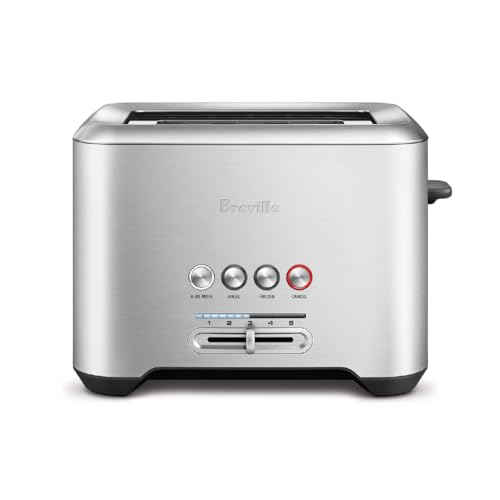
Best overallBreville
5-inch slots are the widest of any 2-slice toasterhere, handling bagels without compression.
- Thermostatic (Element IQ) shade control
- 1.5-inch wide slots
- Lift-and-look mid-cycle inspection
- 6-shade settings plus bagel and frozen modes
- Die-cast zinc alloy housing
✓ Pros
- Same thermostatic browning consistency as the 4-slice BTA840XL, just in a smaller footprint
- 1.5-inch slots are the widest of any 2-slice toasterhere, handling bagels without compression
- Lift-and-look avoids resetting the cycle when checking progress
- Die-cast housing feels noticeably more solid than the stamped-metal budget models
✕ Cons
- The most expensive 2-slice toaster in this roundup by a wide margin
- 1-year warranty is shorter than the Cuisinart CPT-320's 3-year coverage
- Die-cast finish shows fingerprints and needs regular wiping
Top pickBreville
It stands out for thermostatic shade control, same shade setting produces consistent results on a cold and warm toaster and lift-and-look feature, check toast without canceling the cycle.
- Thermostatic (Element IQ) shade control, not timer-based
- Four 1.5-inch wide slots
- Lift-and-look mid-cycle inspection
- Independent shade dials for left and right slot pairs
- Dedicated bagel, frozen, and reheat functions
- Die-cast zinc alloy housing, 5.5 lb
✓ Pros
- Thermostatic shade control, same shade setting produces consistent results on a cold and warm toaster
- Lift-and-look feature, check toast without canceling the cycle
- 1.5-inch wide slots accommodate thick artisan bread, large bagels, and English muffins
- Even browning top-to-bottom across the full slot height
- Die-cast housing, substantial build quality, stays cool to the touch
✕ Cons
- Heavier than most toasters (5.5 lb), moving it to clean under is slightly more effort
- Die-cast finish shows fingerprints and requires regular wiping to mainta in appearance
- The lift-and-look mechanism adds complexity, more parts in the carriage to wear
FAQ
Common questions
Is it worth spending $80 on a toaster?
For daily toast eaters over 4 to 6 years: yes, if uneven browning bothers you. At shade setting 3 on a Breville: the top edge matches the center matches the bottom edge. At shade setting 3 on a budget toaster: the top edge and bottom edge are commonly 1.5 shades darker than the center. Whether this matters depends on whether you notice uneven toast as a nuisance or not. For households w here someone regularly complains about the edges being too dark: the Breville solves this.
What toaster should I get for thick sourdough bread?
Wide-slot toasters (1.5 inches) are required for thick sourdough. Recommended: Breville BTA840XL (1.5-inch wide slots, even heat distribution), Cuisinart CPT-435 (1.5-inch slots, consistent browning), or KitchenAid KMT4116 long-slot (1.5-inch wide, 12-inch long slots for wider boule slices). Verify the slot width specification before purchasing, some toasters listed as 'wide slot' are 1.25 inches, which fits standard bagels but not thick artisan bread without forcing.
Should I unplug my toaster when not in use?
For fire safety: yes, after each use is the safest practice. A plugged-in toaster with accumulated crumbs is a fire risk if a crumb makes contact with the element during a power surge or if a small animal or insect triggers the mechanism. Practically: unplugging after each use and re-plugging the next morning adds approximately 3 to 5 seconds per use. Most households leave the toaster plugged in. The fire risk is real but low, the most effective risk reduction is cleaning the crumb tray every 3 to 5 uses, which removes the fuel source regardless of whether the toaster is plugged in.
Keep researching
Related guides & comparisons