Start With What You Plan to Dry
Meat (jerky, dog treats): Requires a thermostat that reaches at least 160°F for the USDA-recommended safe-start step.
Not every budget dehydrator hits this; verify before buying if jerky is a priority.
Fruit and vegetables: Most dry well in the 125°F to 140°F range.
Nearly every dehydrator on the market covers this comfortably.
Herbs: Benefit from a genuinely low floor, ideally 95°F or below, to preserve color and essential oils.
Decide How Much Airflow Evenness Matters
Horizontal airflow (rear-mounted fan, used by Excalibur and COSORI Premium) dries every tray at close to the same rate without rotation.
This costs more but saves hands-on time, particularly valuable for long overnight cycles like jerky.
Vertical stack airflow (top or bottom-mounted fan, used by NESCO and Presto) costs less but dries the tray closest to the fan faster than trays farther away.
Rotating trays partway through a cycle closes most of the gap, a manageable extra step for occasional use.
Neither approach produces worse food, one simply asks more of you during the drying process.
Match Capacity to How Often You'll Use It
A household drying a few herbs occasionally doesn't need 10 trays.
A household processing a garden harvest every fall or making jerky in bulk will run out of room fast with a 5-tray starter unit.
Expandable tray systems, common on NESCO and Presto, let you start small and add capacity only if you end up using the dehydrator regularly, a lower-risk way to find the right size for your actual habits.
Weigh Digital Versus Analog Controls
Digital controls, standard on COSORI Premium and Presto, offer more precise temperature setting, often in 1°F increments, and easier-to-read timers.
Analog dials, common on NESCO and older models, are simpler and have fewer parts that can fail over years of use, but offer less precision.
For most home users, either works fine.
Precision matters more if you're regularly drying meat and want to hold an exact safe temperature.
Our picks
Products we recommend
As an Amazon Associate I earn from qualifying purchases. Picks are based on manufacturer specs, independent reviews and owner reports.
Best overallNESCO
160°F ceiling covers both the meat safe-start step and vegetable-based treats
- Adjustable thermostat, 95°F to 160°F
- 5 trays included, expandable to 12
- 600W top-mounted fan
- Jumbo Works jerky kit compatible for meat treats
- Compact stackable design
✓ Pros
- 160°F ceiling covers both the meat safe-start step and vegetable-based treats
- Compact size is practical for smaller households making treats in occasional batches
- Expandable trays scale up as you make treats more regularly
- Large owner base with tens of thousands of ratings backing its reliability
✕ Cons
- 5-tray starting capacity limits batch size for larger dogs or multiple pets
- Top-mounted fan dries the top tray faster, so rotating trays helps with even treats
- Round trays aren't ideal for laying out long jerky-style strips
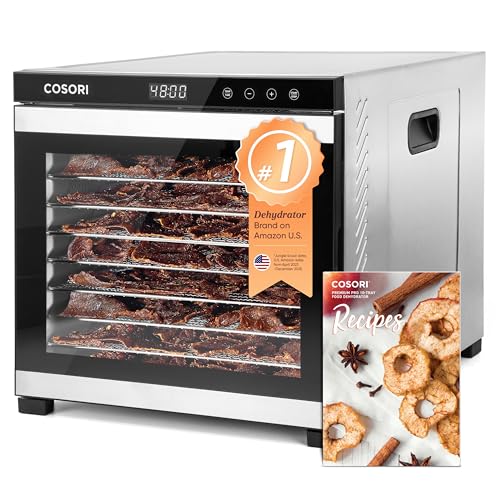
COSORI
1°F increments make it easy to hold precisely at 160°F for the meat safe-start step
- 95°F to 165°F in 1°F increments
- 10 stainless steel trays, 16.2 square feet
- Jerky preset works well for chicken and liver treats
- Rear-mounted horizontal airflow
- 48-hour digital timer
✓ Pros
- 1°F increments make it easy to hold precisely at 160°F for the meat safe-start step
- 10-tray capacity handles both a batch of meat treats and vegetable treats simultaneously
- Jerky preset works directly for chicken jerky and liver treats
- Stainless trays hold up well to repeated raw meat contact
✕ Cons
- Higher price than the NESCO for someone making treats only occasionally
- Large footprint similar to the Excalibur
- Newer to the market with less long-term owner data than NESCO or Excalibur
Excalibur
9-tray capacity makes large batches practical for multi-dog households
- 9 stainless steel trays, 15 square feet of drying space
- Parallex horizontal airflow
- Adjustable thermostat, 105°F to 165°F
- 26-hour digital timer
- Stainless steel trays resist odor absorption
✓ Pros
- 9-tray capacity makes large batches practical for multi-dog households
- Stainless steel trays clean up more easily after fatty meat treats than plastic
- Horizontal airflow dries meat and vegetable treats evenly without rotation
- Long 26-hour timer covers longer vegetable-based treat batches without restarting
✕ Cons
- Highest price on this list, more than most casual treat makers need
- Large footprint takes real counter or storage space
- Overkill for a household making treats for a single small dog occasionally
FAQ
Common questions
What's the single most important spec when choosing a dehydrator?
Temperature range, specifically whether it reaches at least 160°F for meat safety and drops down to around 95°F for delicate herbs and fruit. Every other spec (tray count, airflow design, digital versus analog controls) matters less than whether the unit can actually hold the right temperature for what you plan to dry.
Do I need horizontal airflow, or is a vertical stack fine?
It depends on how much rotation you're willing to do. Horizontal airflow dehydrators (Excalibur, COSORI Premium) dry every tray at close to the same rate without intervention. Vertical stack dehydrators (NESCO, Presto) cost less but need trays rotated partway through longer cycles for even results. Neither produces worse final results, one just requires more hands-on attention.
How many trays do I actually need?
For 1 to 2 people drying occasionally: 5 to 6 trays is workable, especially with an expandable system. For regular use, large jerky batches, or a household processing a garden harvest: 9 to 10 trays saves significant time by avoiding multiple batches. Most expandable budget models let you start small and add trays later.
Should I buy based on price or capability first?
Capability first, specifically the temperature range and airflow design, then find the best price with in that capability tier. A cheap dehydrator that can't hold 160°F rules out meat entirely, and a cheap unit with a single weak fan will need much more hands-on tray rotation than a similarly priced horizontal-airflow model.
Keep researching
Related guides & comparisons