As an Amazon Associate I earn from qualifying purchases. Picks are based on manufacturer specs, independent reviews and owner reports.
Our top picks
Short on time? Our top recommendation is the NESCO FD-75A Snackmaster Pro Food Dehydrator.
Compare
At a glance
The traits that separate these picks, side by side.
| # | Product | Best for | Key feature | |
|---|
| 1 | | — | Adjustable thermostat, 95°F to 160°F | Check ↗ |
| 2 | | — | 9 stainless steel trays, 15 square feet of drying space | Check ↗ |
| 3 | | — | 95°F to 165°F in 1°F increments | Check ↗ |
| 4 | | — | Digital thermostat and timer, 90°F to 165°F | Check ↗ |
In depth
The 4 best, explained
Why each made the cut, where it falls short, and who should buy it.
Best overallNESCO
160°F ceiling covers both the meat safe-start step and vegetable-based treats
- Adjustable thermostat, 95°F to 160°F
- 5 trays included, expandable to 12
- 600W top-mounted fan
- Jumbo Works jerky kit compatible for meat treats
- Compact stackable design
✓ Pros
- 160°F ceiling covers both the meat safe-start step and vegetable-based treats
- Compact size is practical for smaller households making treats in occasional batches
- Expandable trays scale up as you make treats more regularly
- Large owner base with tens of thousands of ratings backing its reliability
✕ Cons
- 5-tray starting capacity limits batch size for larger dogs or multiple pets
- Top-mounted fan dries the top tray faster, so rotating trays helps with even treats
- Round trays aren't ideal for laying out long jerky-style strips
Excalibur
And stainless steel trays clean up more easily after fatty meat treats than plastic. The tradeoff: highest price on this list, more than most casual treat makers need.
- 9 stainless steel trays, 15 square feet of drying space
- Parallex horizontal airflow
- Adjustable thermostat, 105°F to 165°F
- 26-hour digital timer
- Stainless steel trays resist odor absorption
✓ Pros
- 9-tray capacity makes large batches practical for multi-dog households
- Stainless steel trays clean up more easily after fatty meat treats than plastic
- Horizontal airflow dries meat and vegetable treats evenly without rotation
- Long 26-hour timer covers longer vegetable-based treat batches without restarting
✕ Cons
- Highest price on this list, more than most casual treat makers need
- Large footprint takes real counter or storage space
- Overkill for a household making treats for a single small dog occasionally
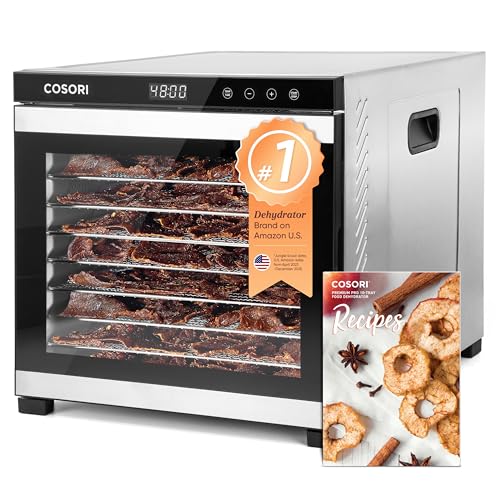
COSORI
2 square feet. The tradeoff: higher price than the NESCO for someone making treats only occasionally.
- 95°F to 165°F in 1°F increments
- 10 stainless steel trays, 16.2 square feet
- Jerky preset works well for chicken and liver treats
- Rear-mounted horizontal airflow
- 48-hour digital timer
✓ Pros
- 1°F increments make it easy to hold precisely at 160°F for the meat safe-start step
- 10-tray capacity handles both a batch of meat treats and vegetable treats simultaneously
- Jerky preset works directly for chicken jerky and liver treats
- Stainless trays hold up well to repeated raw meat contact
✕ Cons
- Higher price than the NESCO for someone making treats only occasionally
- Large footprint similar to the Excalibur
- Newer to the market with less long-term owner data than NESCO or Excalibur
Presto
165°F ceiling handles the meat safe-start step with room to spare
- Digital thermostat and timer, 90°F to 165°F
- 6 trays included, expandable to 12
- Bottom-mounted fan
- Nesting trays for storage
- Includes mesh screens and fruit roll sheets
✓ Pros
- 165°F ceiling handles the meat safe-start step with room to spare
- Lower price than NESCO or COSORI for a first attempt at homemade treats
- Nesting trays make storage easy for occasional treat-making sessions
- Digital controls are simple to set and read
✕ Cons
- 6-tray starting capacity is modest for larger dogs or bigger batches
- Bottom fan means the lowest tray dries fastest, worth checking individually
- Round trays limit efficient layout for long jerky-style strips
How we chose these picks
Every pick below earned its place through documented strengths, verified specifications, consistent praise in reputable reviews, and owner-feedback patterns. We don't sell placements, and we don't invent test scores.
Mistakes buyers often make
- Buying on brand name alone instead of matching features to your actual use case.
- Overpaying for headline specs you'll never use, define must-haves first.
- Ignoring size — compatibility, and ongoing costs (filters, accessories, refills).
- Trusting star ratings without reading what owners compla in about after 6 months.
How to choose: the factors that matter
- Capacity and sizing — Measure your space and your actual use before falling for bigger-is-better. The right size is the one that fits your routine, not the spec sheet's maximum.
- Build quality and materials — Heavier-gauge materials, tight tolerances, and solid joints outlast thin, rattly construction. In reviews, look for longevity comments over first-impression praise.
- Ease of use and setup — Clear instructions, intuitive controls, and minimal assembly separate daily drivers from garage ornaments.
- Maintenance and cleaning — Whatever you buy will need cleaning. Removable, dishwasher-safe, or wipe-clean parts get maintained; fiddly ones get neglected.
- Warranty and support — A multi-year warranty signals the manufacturer expects it to last. Check what's actually covered, motors and frames matter more than accessories.
The bottom line
There's no single 'best' here, only the best match for your situation. Start from your must-have features, then choose the least expensive pick that covers them.
FAQ
Common questions
What are the best food dehydrators for homemade dog treats right now?
Our top pick is the NESCO FD-75A Snackmaster Pro Food Dehydrator (best overall), because 160°F ceiling covers both the meat safe-start step and vegetable-based treats. The runner-up is the Excalibur D900CDSHD 9-Tray Food Dehydrator, followed by the COSORI Premium 10-Tray Stainless Steel Food Dehydrator.
Is the NESCO FD-75A Snackmaster Pro Food Dehydrator worth it?
For most buyers, yes. It ranks #1 in our food dehydrators for homemade dog treats research, though 5-tray starting capacity limits batch size for larger dogs or multiple pets.
What temperature should I use for dog treats?
For meat-based treats like chicken jerky or liver, 160°F to start kills bacteria, then finishing at 130°F to 145°F dries the treat through. For sweet potato, pumpkin, or vegetable-based treats, 125°F to 135°F works well without scorching. All four dehydrators on this list reach the full range needed for either type.
Is it safe to make chicken jerky treats at home for dogs?
Yes, when dried thoroughly and at the right temperature. Home-dried chicken jerky should reach 160°F during the process to reduce bacterial risk, then be dried until fully firm with no soft or moist spots. Store finished treats in the refrigerator or freezer if not using with in a week or two, since homemade treats lack the preservatives that commercial jerky treats use.
How long do homemade dog treats take to dehydrate?
Sweet potato slices typically take 6 to 10 hours at 125°F to 135°F depending on thickness. Meat-based treats like chicken strips or liver take 4 to 8 hours at 130°F to 145°F after the initial safe-heat step. Thicker cuts and treats with higher moisture content take longer; check texture starting at the low end of the range.
How should I store homemade dog treats?
Fully dried treats with no moisture pockets can be stored in an airtight container at room temperature for 1 to 2 weeks. For longer storage, refrigerate for up to a month or freeze for several months. If treats develop any off smell or visible moisture inside the container, discard them, since homemade treats lack commercial preservatives.
Keep researching
Related guides & comparisons