Temperature Range
The single most important spec.
Look for a range that covers at least 95°F to 160°F if you plan to dry a mix of foods.
Meat needs the 160°F safe-start step; herbs and delicate fruit dry best closer to 95°F to 110°F.
A dehydrator that tops out at 145°F or bottoms out at 130°F rules out entire categories of food.
1°F increment control, found on the COSORI Premium, is a genuine precision upgrade over coarser dials, useful for anyone who wants to hold an exact temperature rather than an approximate range.
Airflow Design
Horizontal (rear-mounted fan): Used by the Excalibur and COSORI Premium.
Dries every tray at close to the same rate without rotation.
Costs more but saves hands-on attention during long cycles.
Vertical (top or bottom-mounted fan): Used by the NESCO and Presto.
Costs less but dries the tray nearest the fan faster than trays farther away, requiring a mid-cycle rotation for even results.
Tray Material and Shape
Stainless steel (Excalibur, COSORI Premium) resists staining and odor absorption from meat and tomato-based foods better over years of regular use, and generally handles hand-washing well.
Plastic (NESCO, Presto) is lighter and often less expensive to replace individually if a tray cracks, but can pick up stains and odors more readily over time.
Square trays (Excalibur, COSORI) use more of the total quart or square-foot rating than round trays, since rectangular foods like chicken strips fit more efficiently without wasted curved corners.
Timer and Auto Shut-Off
Auto shut-off is a meaningful safety and convenience feature, particularly for overnight cycles.
It prevents food from over-drying if a cycle runs longer than planned and reduces the risk of leaving a heating appliance running unattended for excessive periods.
Most dehydrators above the most basic budget tier include this now.
Wattage
Higher wattage (the COSORI Premium's 1000W versus the NESCO's 600W) means faster temperature recovery when cold or frozen food is loaded, and can shave time off preheating.
It's a real but secondary factor, worth considering but not worth prioritizing over temperature range or airflow design.
Noise Level
Most dehydrators run at a moderate, steady hum.
Horizontal-airflow models with more powerful fans, like the Excalibur, tend to run a bit louder than compact single-fan vertical models.
For long overnight cycles in a space adjacent to a bedroom, this is worth a moment's thought, though most owners describe it as unobtrusive background noise.
Capacity and Expandability
Starting tray count matters less than whether the system is expandable.
NESCO and Presto both let you start with 5 to 6 trays and add more later, a lower-risk way to size up only if you end up using the dehydrator regularly, rather than committing to a large unit upfront.
Quick Spec Priority
Temperature range (95°F to 160°F minimum, wider is better) Airflow design (horizontal for hands-off drying, vertical for lower cost) Tray material (stainless for durability, plastic for lower replacement cost) Timer with auto shut-off (worth having on any unit) Wattage and noise (secondary factors, worth a glance but not a priority)
Our picks
Products we recommend
As an Amazon Associate I earn from qualifying purchases. Picks are based on manufacturer specs, independent reviews and owner reports.
Best overallNESCO
160°F ceiling covers both the meat safe-start step and vegetable-based treats
- Adjustable thermostat, 95°F to 160°F
- 5 trays included, expandable to 12
- 600W top-mounted fan
- Jumbo Works jerky kit compatible for meat treats
- Compact stackable design
✓ Pros
- 160°F ceiling covers both the meat safe-start step and vegetable-based treats
- Compact size is practical for smaller households making treats in occasional batches
- Expandable trays scale up as you make treats more regularly
- Large owner base with tens of thousands of ratings backing its reliability
✕ Cons
- 5-tray starting capacity limits batch size for larger dogs or multiple pets
- Top-mounted fan dries the top tray faster, so rotating trays helps with even treats
- Round trays aren't ideal for laying out long jerky-style strips
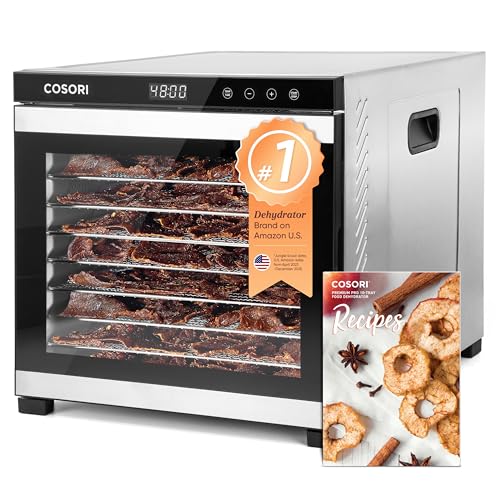
COSORI
1°F increments make it easy to hold precisely at 160°F for the meat safe-start step
- 95°F to 165°F in 1°F increments
- 10 stainless steel trays, 16.2 square feet
- Jerky preset works well for chicken and liver treats
- Rear-mounted horizontal airflow
- 48-hour digital timer
✓ Pros
- 1°F increments make it easy to hold precisely at 160°F for the meat safe-start step
- 10-tray capacity handles both a batch of meat treats and vegetable treats simultaneously
- Jerky preset works directly for chicken jerky and liver treats
- Stainless trays hold up well to repeated raw meat contact
✕ Cons
- Higher price than the NESCO for someone making treats only occasionally
- Large footprint similar to the Excalibur
- Newer to the market with less long-term owner data than NESCO or Excalibur
Excalibur
9-tray capacity makes large batches practical for multi-dog households
- 9 stainless steel trays, 15 square feet of drying space
- Parallex horizontal airflow
- Adjustable thermostat, 105°F to 165°F
- 26-hour digital timer
- Stainless steel trays resist odor absorption
✓ Pros
- 9-tray capacity makes large batches practical for multi-dog households
- Stainless steel trays clean up more easily after fatty meat treats than plastic
- Horizontal airflow dries meat and vegetable treats evenly without rotation
- Long 26-hour timer covers longer vegetable-based treat batches without restarting
✕ Cons
- Highest price on this list, more than most casual treat makers need
- Large footprint takes real counter or storage space
- Overkill for a household making treats for a single small dog occasionally
FAQ
Common questions
Is a higher wattage dehydrator always better?
Wattage affects how quickly a unit reaches and recovers temperature, useful when loading a full batch of cold food, but it doesn't determine final drying quality on its own. Airflow design and temperature accuracy matter more for even results than raw wattage.
Do I need a timer with auto shut-off?
It's a genuinely useful safety and convenience feature, especially for long overnight cycles like jerky or fruit leather. Without auto shut-off, an unattended dehydrator running past the intended finish time can over-dry food or, in rare cases, pose a fire risk if left running indefinitely. Most dehydrators above budget-tier now include this.
What's the difference between plastic and stainless steel trays?
Stainless steel trays, used on the Excalibur and COSORI Premium, resist staining and odor absorption from meat marinades and tomato-based foods better over years of use, and generally feel more durable. Plastic trays, common on NESCO and Presto, are lighter and often cheaper to replace individually, but can pick up stains and odors over time.
Should I worry about dehydrator noise?
For most kitchens, no, dehydrators run at a moderate hum comparable to a box fan on low. It's worth considering if the unit will run for 8-plus hours overnight in a bedroom-adjacent space, w here horizontal-airflow models with more powerful fans (like the Excalibur) run somewhat louder than compact single-fan models.
Keep researching
Related guides & comparisons