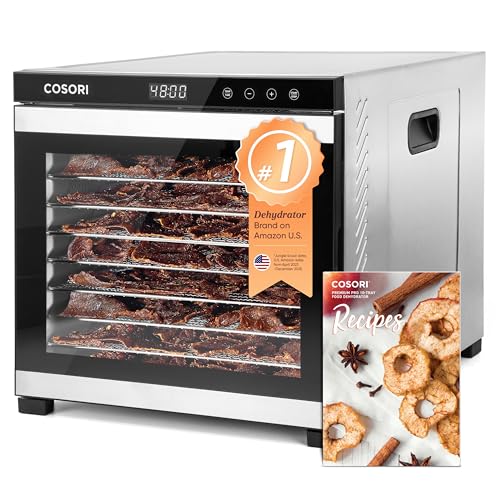
COSORI Premium
COSORI
Prices and availability change, so confirm on Amazon.View on Amazon
COSORI Premium vs Presto Dehydro Digital: we break down the real differences, strengths, tradeoffs, and which one fits your situation.
As an Amazon Associate I earn from qualifying purchases. Picks are based on manufacturer specs, independent reviews and owner reports.
Buy the COSORI Premium if you want horizontal airflow without rotating trays, plan to dry in larger batches, and have the space for a bigger appliance. Buy the Presto Dehydro Digital if you want digital controls at a lower price, have limited storage space, and don't mind rotating trays for longer cycles.
The differences that actually change the buying decision.
Buy the COSORI Premium if you want horizontal airflow without rotating trays, plan to dry in larger batches, and have the space for a bigger appliance.
Buy the Presto Dehydro Digital if you want digital controls at a lower price, have limited storage space, and don't mind rotating trays for longer cycles.
Digital controls: Both offer digital thermostats and timers, a step up from analog dials on the cheapest dehydrators.
Temperature ceiling: Both reach 165°F, comfortably covering the meat safe-start step.
Build quality: Both feel solidly constructed for their respective price points.
Airflow evenness: Horizontal airflow across all 10 trays means no rotation needed, a real time-saver for long cycles.
Capacity: 16.2 square feet handles noticeably larger batches in a single run than the Presto's smaller starting footprint.
Temperature precision: 1°F increments beat the Presto's coarser digital steps for anyone who wants to dial in an exact setting.
Price: Roughly half the COSORI's typical cost while still offering digital controls.
Storage: Nesting trays and a smaller starting footprint make this the easier option to tuck away in a smaller kitchen.
Included accessories: Fruit roll sheets and mesh screens typically ship in the box, ready to use immediately.
COSORI Premium: larger or more frequent batches, wants horizontal airflow, has space for a bigger unit.
Presto Dehydro Digital: smaller budget, limited storage space, comfortable rotating trays occasionally.
Presto Dehydro Digital on Amazon
Bottom line
Buy the COSORI Premium if you want horizontal airflow without rotating trays, plan to dry in larger batches, and have the space for a bigger appliance. Buy the Presto Dehydro Digital if you want digital controls at a lower price, have limited storage space, and don't mind rotating trays for longer cycles.
COSORI
Presto
FAQ
For anyone drying in larger batches or who wants to skip rotating trays, yes. The horizontal airflow and nearly double the drying space are meaningful upgrades. For occasional small batches on a tighter budget, the Presto covers the same core temperature range for less.
The Presto ships with fruit roll sheets and mesh screens included in most bundles, ready to use immediately. COSORI Premium bundles vary, and some accessories like fruit roll sheets may be sold separately, so check the specific listing before buying if accessories matter to your decision.
The Presto's bottom-mounted fan dries the lowest tray faster than trays higher in the stack, requiring a mid-cycle rotation for even results on longer dries like jerky or fruit leather. The COSORI's horizontal airflow avoids this extra step entirely.
Its 6-tray starting size and nesting tray design take up less space both in use and in storage. The COSORI's 10-tray capacity and horizontal-airflow cabinet are noticeably larger and better suited to a kitchen with more available counter or pantry space.
Keep researching