How to fix it
Work through these in order, the most common causes come first.
Start With the Basics
Re-check strap tightness for a packed load.
Straps set for an empty bag often need loosening once the bag carries a full travel packing list, since the weight sits differently against the shoulders.
Engage the hip belt properly, if the bag has one.
A hip belt that sits on the hip bones and is tightened correctly transfers real weight off the shoulders.
Worn loose or positioned too high, it does little.
Diagnosing Your Specific Problem
Straps dig in evenly on both shoulders: likely an overall adjustment or hip belt issue.
Loosen straps slightly, then engage and tighten the hip belt properly if the bag has one.
Straps dig in more on one side: almost always uneven internal weight distribution.
Repack with heavier items centered and low, close to your back.
Straps dig in regardless of adjustment or repacking: check whether the bag's torso length actually matches your body.
Our picks
Products we recommend
As an Amazon Associate I earn from qualifying purchases. Picks are based on manufacturer specs, independent reviews and owner reports.
Cotopaxi
35L sits closest to budget-carrier personal item limits among purpose-built travel packs
- 35L suitcase-style opening
- 1000D TPU-coated polyester, recycled fabrics
- Air-mesh back panel
- Removable hip belt
- Luggage pass-through strap
✓ Pros
- 35L sits closest to budget-carrier personal item limits among purpose-built travel packs
- Suitcase-style opening suits repacking quietly in shared hostel rooms
- Durable shell holds up over weeks of tra in stations and cobblestone streets
✕ Cons
- Even at 35L, some strict Ryanair-style sizers may still flag it at the gate
- Th in hip belt offers less support than a hiking-style harness on long walking days
- Limited external organization for quick-grab items like a passport or phone
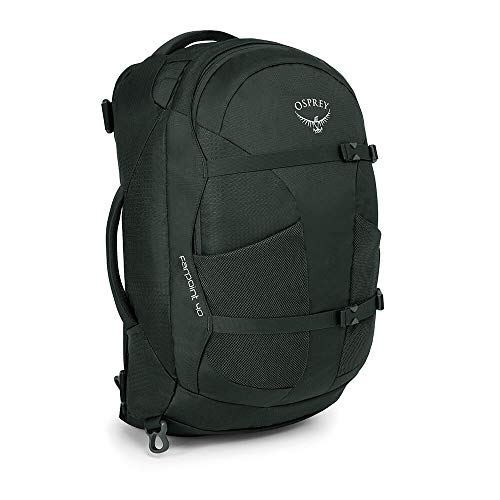
Osprey
Frame suspension and hipbelt carry weight better on long walks between tra in stations
- 40L with removable 11L daypack
- LightWire frame suspension
- Stowable harness
- Zip-away hipbelt
- Lockable ma in compartment
✓ Pros
- Frame suspension and hipbelt carry weight better on long walks between tra in stations
- Removable daypack works as a day bag for sightseeing without the ma in pack
- Widely used by long-term backpackers, with a strong multi-year durability track record
✕ Cons
- 40L exceeds several budget-carrier personal item limits, may incur a gate fee
- Two-piece system is bulkier than a single travel pack when both pieces are combined
- Higher price than the Cotopaxi packs at typical retail
Peak Design
Its case rests on compresses to a smaller, stricter-sizer-friendly footprint when needed and three separate access points make it easy to grab items without unpacking.
- Expands from 35L to 45L via external compression straps
- Weatherproof 400D recycled nylon canvas shell
- Rear, top, and side access with MagLatch closures
- Tuck-away hip belt and sternum strap
- Compatible with Peak Design packing cubes and camera cubes
✓ Pros
- Compresses to a smaller, stricter-sizer-friendly footprint when needed
- Three separate access points make it easy to grab items without unpacking
- Weatherproof shell holds up in ra in at bus stops and gate walks
✕ Cons
- Tuck-away straps take a bit of practice to stow cleanly
- Heavier than the Osprey Farpoint 40 when fully packed
FAQ
Common questions
Why do my backpack straps dig in more on travel days than everyday use?
Travel packing tends to be heavier and more front-loaded than everyday carrying, and a bag that feels fine at half load can dig in noticeably once packed for a full trip. Straps that were adequately padded for lighter daily use may not distribute a fully packed travel load comfortably, especially without a hip belt to share the weight.
Does a hip belt actually help with strap digging, or just add bulk?
A properly adjusted hip belt genuinely helps, since it transfers a meaningful portion of the bag's weight from the shoulder straps to the hips, which is w here the body can bear load more comfortably over long periods. A hip belt worn loose or positioned too high defeats this purpose and leaves the shoulders carrying the full load anyway.
Is strap digging a sign the backpack is the wrong size for me?
If the torso length of the bag doesn't match your body (too long or too short), the shoulder straps can sit at the wrong angle and dig in regardless of adjustment. Brands like Osprey publish specific torso-length-based sizing (S/M vs M/L on the Farpoint 40) precisely because this mismatch is a common cause of strap discomfort.
Keep researching
Related guides & comparisons