Plug Type Standards
Type A/B (flat parallel pins, sometimes with a round ground pin): North America, Central America, Japan, and parts of South America.
Type C/E/F (two round pins): most of continental Europe, plus parts of Asia, South America, and Africa.
Type G (three rectangular pins): the UK, Ireland, Hong Kong, Singapore, and Malaysia.
Type I (angled flat pins): Australia, New Zealand, China, and parts of the Pacific.
Type D/M (larger round pins): India, South Africa, and parts of Africa.
Plug Adaptation vs Voltage Conversion
This is the most consequential distinction in the category.
A plug adapter changes only the physical shape of the plug.
The electrical current passing through it is unchanged.
Nearly all phone, laptop, tablet, and camera chargers are dual voltage, meaning they list an input range like 100-240V on the brick itself, and only need a plug adapter to work anyw here in the world.
A voltage converter is a different product.
USB-A vs USB-C on Travel Adapters
A standard USB-A port typically delivers up to 2.4A, adequate for charging a phone overnight but slow for tablets or larger devices.
A USB-C port with Power Delivery (PD) support, typically rated 18W or higher on travel adapters, charges PD-compatible phones and tablets meaningfully faster.
Check the specific wattage listed, not just whether a port is labeled USB-C, since a non-PD USB-C port charges no faster than USB-A.
Safety Features Worth Paying For
Built-in fuse: protects against power surges damaging connected devices.
This should be present on every adapter, even budget models.
Safety shutters: block accidental contact with live pins when the adapter isn't in use.
An inexpensive feature that's a red flag when absent.
Surge protection: a more robust safeguard than a basic fuse, worth the modest price increase for expensive electronics on unfamiliar hotel wiring.
Our picks
Products we recommend
As an Amazon Associate I earn from qualifying purchases. Picks are based on manufacturer specs, independent reviews and owner reports.
OREI
Small enough to keep in a daypack pocket for daily sightseeing
- Slide-out plug attachments including Type C/E/F and Type G
- 2 USB-A ports plus 1 universal AC outlet
- Safety shutters and fuse protection
- Compact size
✓ Pros
- Small enough to keep in a daypack pocket for daily sightseeing
- Safety shutters block accidental contact with live pins
✕ Cons
- Only one AC outlet limits simultaneous device charging
- USB ports top out at 2A, slower than PD-equipped alternatives
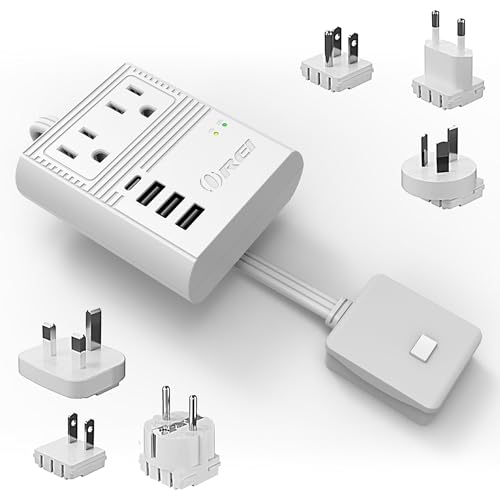
OREI
Six total charging points from a single European hotel outlet
- Interchangeable plug heads for Europe and the UK
- 2 USA outlets, 3 USB-A ports, 1 USB-C PD 18W port
- Grounded 3-prong design
✓ Pros
- Six total charging points from a single European hotel outlet
- 18W USB-C PD charges a phone noticeably faster than USB-A-only kits
- Grounded design adds safety marg in for laptop chargers
✕ Cons
- Larger and heavier than a simple plug-only adapter
- 18W PD is not enough to fast-charge most laptops
BESTEK
Genuine step-down voltage conversion, not just a plug shape adapter, matters for single-voltage hair tools
- 100-220V to 110V step-down voltage conversion, 250W
- 6A 4-port USB charging
- 3 AC sockets
- EU/UK/AU/US/India plug attachments
- Covers 150+ countries
✓ Pros
- Genuine step-down voltage conversion, not just a plug shape adapter, matters for single-voltage hair tools
- Three AC sockets plus four USB ports cover a full family's devices from one wall plug
- Wide plug attachment set covers most common destinations
✕ Cons
- 250W ceiling means it cannot run high-draw appliances like full-size hair dryers
- Bulkier and heavier than plug-only adapters since it houses conversion electronics
- Audible fan noise reported by some owners during conversion
FAQ
Common questions
What plug types exist and w here are they used?
Type A/B: North America, Central America, Japan, parts of South America. Type C/E/F: most of continental Europe, plus parts of Asia, South America, and Africa. Type G: UK, Ireland, Hong Kong, Singapore, Malaysia. Type I: Australia, New Zealand, China, parts of the Pacific. Type D/M: India, South Africa, parts of Africa. A universal adapter with interchangeable heads covers all of these in one device.
What's the real difference between a travel adapter and a voltage converter?
A travel adapter changes only the physical plug shape so it fits a foreign outlet. It does nothing to the electrical current. A voltage converter (or transformer) actually steps the incoming voltage up or down to match what a device needs. Most modern electronics are dual voltage and only need an adapter. Single-voltage appliances need a genuine converter, a heavier, bulkier, and more expensive product.
Is USB-C always faster than USB-A on a travel adapter?
Only if the USB-C port supports Power Delivery (PD) at a meaningful wattage, typically 18W or higher, and your device supports receiving PD fast charging. A USB-C port without PD support charges no faster than a standard USB-A port. Check the specific wattage rating on the adapter's USB-C port, not just its presence, before assuming it will charge faster.
Keep researching
Related guides & comparisons