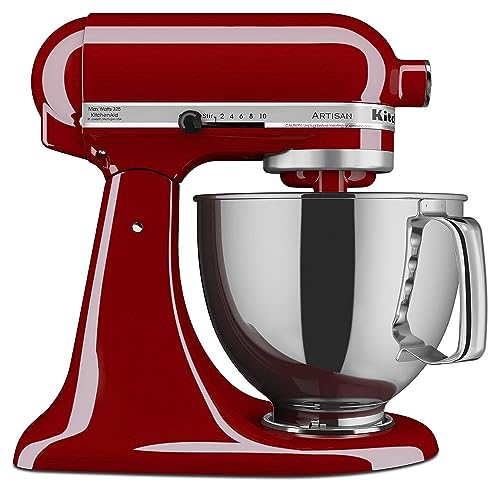
KitchenAid
KitchenAid
Prices and availability change, so confirm on Amazon.View on Amazon
KitchenAid vs Cuisinart Stand Mixer: we break down the real differences, strengths, tradeoffs, and which one fits your situation.
As an Amazon Associate I earn from qualifying purchases. Picks are based on manufacturer specs, independent reviews and owner reports.
Buy the KitchenAid Artisan if: You plan to use pasta roller, meat grinder, or other non-baking attachments You want 30+ color options for kitchen matching
The differences that actually change the buying decision.
Both are quality full-metal stand mixers.
The attachment ecosystem is the defining difference.
Attachment ecosystem: 15+ official KitchenAid accessories share the same hub, and every tilt-head KitchenAid made since 1993 is compatible.
The pasta roller alone is a frequently cited reason for buying KitchenAid over a lower-priced alternative.
No other consumer stand mixer offers equivalent attachment breadth.
Motor wattage: 500W vs 325W.
On dense or stiff dough, the Cuisinart has more raw power available.
In everyday baking tasks: the difference is rarely noticed.
Buy the KitchenAid Artisan if: You plan to use pasta roller, meat grinder, or other non-baking attachments You want 30+ color options for kitchen matching Community recipes, videos, and troubleshooting resources matter
Bottom line
Buy the KitchenAid Artisan if: You plan to use pasta roller, meat grinder, or other non-baking attachments You want 30+ color options for kitchen matching
KitchenAid
Cuisinart
FAQ
The premium is justified by one thing: the attachment ecosystem. If you plan to add a pasta roller, meat grinder, ice cream maker bowl, spiralizer, or gra in mill to your stand mixer with in the next 5 years: the KitchenAid Artisan is the correct investment. The official KitchenAid pasta roller set, in particular, is the most widely praised kitchen attachment purchase by home cooks and has no real Cuisinart equivalent. The decision comes down to attachment intent, not baking performance.
Both stand mixers are louder than most kitchen appliances at high speeds (speed 8 to 10). At low speeds (speed 2 for bread, speed 4 for creaming): both operate at a moderate hum that allows conversation in the same room. At high speeds (speed 8 to 10 for meringue and whipped cream): both produce a higher-pitched motor whine. The KitchenAid Artisan is generally considered slightly quieter than the Cuisinart SM-50 at equivalent speeds by most users who haveboth, though both are with in a few decibels of each other. Neither is quiet enough for use during phone or video calls. If noise is a priority: neither model is the answer, the Ankarsrum Original is notably quieter due to its direct-drive motor design.
Both stand mixers have dishwasher-safe bowls and attachments (top rack). The KitchenAid Artisan bowl's single-handle design makes it easier to carry and pour; the Cuisinart SM-50's two-handle design provides better grip during transport. The KitchenAid's tilt-head design allows slightly more clearance above the bowl for wiping down the head underside and attachment collar. The Cuisinart's lever-lock tilt-head requires pressing the lever to access the same area. Bowl size: the Cuisinart's 5.5-quart bowl takes slightly more room in the dishwasher than the Artisan's 5-quart. In practice: both machines clean with equal ease and neither has notably difficult-to-reach areas. The attachment count (3 each, standard) and bowl cleaning time are equivalent.
For bread baking 1 to 2 times per week in single-loaf quantities: both the KitchenAid Artisan and Cuisinart SM-50 handle it. The Cuisinart's 500W motor has a slight advantage on stiff doughs and large batches vs the Artisan's 325W, but both handle standard single-loaf bread without difficulty. For bread baking 3+ times per week or double-loaf batches as the primary use: neither the Artisan nor the SM-50 is the ideal choice, both are tilt-head designs; a bowl-lift model (KitchenAid Pro 600, Cuisinart SM-70) is more appropriate for that frequency and the bowl-lift's mechanical stability under repeated heavy dough use. If bread is frequent and bread is most of your baking: see the [best stand mixers for bread](/best-stand-mixers-for-bread) for the bowl-lift recommendations.
Keep researching