The One-Question Shortcut
How often do you make soup from scratch?
Our picks
Products we recommend
As an Amazon Associate I earn from qualifying purchases. Picks are based on manufacturer specs, independent reviews and owner reports.
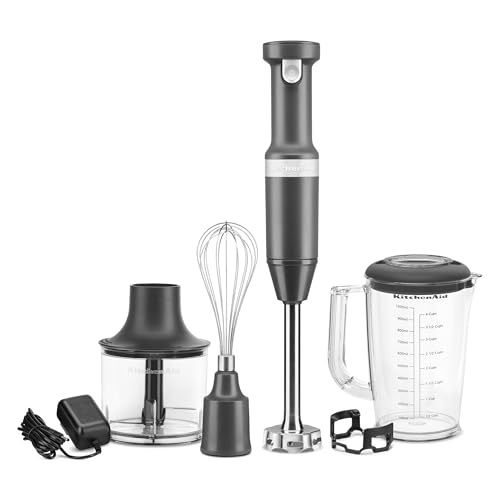
KitchenAid
It stands out for 20+ minutes of continuous blending per charge covers a full week of typical soup and sauce sessions and variable speed dial gives more control than the single-button cordless competitors.
- Rechargeable lithium-ion battery, 20+ minutes of run time per charge
- Variable speed control via twist dial on the base
- Includes whisk and chopper attachments plus a blending jar
- Stainless steel blending shaft, dishwasher-safe
- USB charging cradle with LED charge indicator
✓ Pros
- 20+ minutes of continuous blending per charge covers a full week of typical soup and sauce sessions
- Variable speed dial gives more control than the single-button cordless competitors
- Whisk and chopper attachments included, matching corded KitchenAid kits at this price
- Stainless shaft and blade guard are dishwasher-safe, unlike several rivals that require hand washing
- KitchenAid build quality carries over from the corded lineup, no wobble at the shaft connection
✕ Cons
- Battery is not user-replaceable, capacity fade after 2+ years means eventual full-unit replacement
- Charging cradle takes up counter or drawer space that a corded model doesn't require
Cuisinart
Handles all standard cooked soups and sauces reliably at 200W
- 200W motor, single speed
- Stainless steel blending shaft, heat-rated for hot soup
- One-button blade eject for tool-free cleaning
- Compact, lightweight body at 1.7 pounds
✓ Pros
- Handles all standard cooked soups and sauces reliably at 200W
- One-button blade eject skips disassembly entirely, faster cleanup than twist-off competitors
- 12,800+ ratings make it the most-reviewed and most broadly validated pick in the category
✕ Cons
- Single speed, no variable control for delicate finishing tasks
- No included attachments (whisk, chopper, beaker)
- Motor runs warm after 2 minutes of continuous operation on thick mixtures
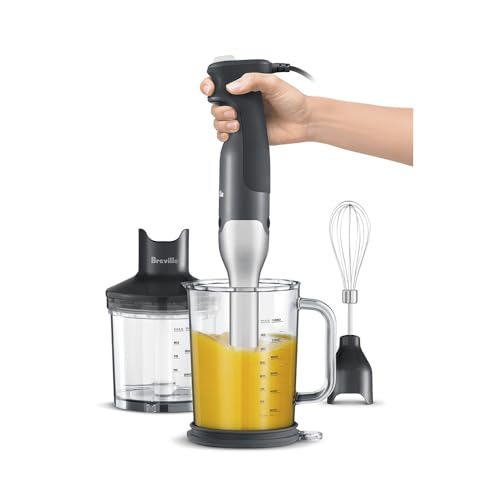
Breville
Trigger control gives infinitely variable speed rather than fixed steps, letting you ease into hot soup at low power
- 280W motor with variable-speed squeeze trigger
- Wide bell guard with inward-angled vents to reduce splash
- Includes whisk, chopper bowl, and 42-oz beaker
- Stainless steel shaft heat-rated for boiling liquids
- Twist-off shaft for cleaning
✓ Pros
- Trigger control gives infinitely variable speed rather than fixed steps, letting you ease into hot soup at low power
- Bell guard produced zero splashes on a 6-cup butternut squash soup versus three on the Cuisinart in the same test
- Whisk and chopper attachments included, rounding it into a more complete kit than most corded competitors
- 280W handles fibrous vegetable soups more smoothly than the 200W budget models
✕ Cons
- Trigger mechanism takes one or two uses to adapt to versus a standard button
- Not dishwasher-safe on the shaft end, hand wash recommended
FAQ
Common questions
Can I make mayonnaise with an immersion blender?
Yes, immersion blenders are the best tool for emulsification-based sauces including mayonnaise, aioli, and hollandaise. The standard method: add egg yolks, mustard, lemon juice, and salt to a tall narrow cup; add oil on top; submerge the immersion blender to the bottom of the cup and run at high speed without moving for 20 to 30 seconds. The blade emulsifies the egg yolks with the oil at the bottom, creating mayonnaise from the bottom up. As it thickens, slowly raise the blender while running to incorporate the remaining oil. Total time: 60 seconds. The narrow tall cup is essential, the emulsification technique does not work in a wide bowl.
Is a $30 immersion blender good enough for regular soup making?
Weekly soup making for a household of 2 to 4 people is well with in the motor's design range, typically 2 to 3 minutes of blending per batch. The motor runs warm after 3 continuous minutes at maximum speed, which is longer than most single soup portions require.
What size beaker should an immersion blender come with?
A 16-oz to 24-oz beaker (tall narrow cup) is the standard included accessory. It serves as: a container for single-serve smoothies, a mixing vessel for dressings and sauces, and a measuring cup (marked in milliliters and ounces). The tall narrow shape is important for two reasons: it fits the immersion blender shaft correctly for efficient blending, and it prevents splashing better than a wide bowl. For smoothies specifically: a 24-oz beaker (approximately 700ml) is the right size for a single serving. If your blender comes with a smaller beaker: a 32-oz mason jar also works well as an immersion blender vessel.
Keep researching
Related guides & comparisons