How to fix it
Work through these in order, the most common causes come first.
Why Food Processors Chop Unevenly
Uneven chopping from a food processor falls into three categories: technique errors (fixes 1 to 3), hardware issues (fixes 4 to 5), and use-case mismatches (fixes 6 to 8).
Work through the technique fixes first, they resolve 70% of uneven chopping complaints without any repairs or purchases.
Cut all food to with in 50% of the same size before processing.
One large quarter and one small sliver produce different results.
Quarter onions; cut carrots into 1-inch pieces.
Our picks
Products we recommend
As an Amazon Associate I earn from qualifying purchases. Picks are based on manufacturer specs, independent reviews and owner reports.
Top pickCuisinart
Smallest practical footprint of any processor in this roundup, fits on a narrow shelf
- 4-cup work bowl, compact 5.25 x 5.75 x 8.5-inch footprint
- Stainless steel chopping blade with auto-reversing action for coarse or fine chop
- Simple two-touch pulse and continuous-on control
- Dishwasher-safe bowl, lid, and blade
- No discs, S-blade only, no slicing or shredding
✓ Pros
- Smallest practical footprint of any processor in this roundup, fits on a narrow shelf
- Auto-reversing blade action produces both coarse chop and fine mince from the same blade
- Easiest lid to remove and clean of any compact model
- 4-cup bowl is exactly right for garlic, herbs, and single-batch salsa or dressing
✕ Cons
- No slicing or shredding discs, S-blade only
- 4-cup bowl is too small for hummus batches serving more than 2 people
- Motor is not rated for dough or dense root vegetables
- Only two speed settings, no variable control
Hamilton Beach
Stack and Snap design is genuinely the fastest assembly and cleanup system in this roundup
- 12-cup work bowl with 450-watt motor
- Stack and Snap assembly, blade locks into the lid, not the bowl, for one-handed setup
- Includes slicing disc and shredding disc
- Bowl-and-blade stacking system reduces drawer storage bulk
- Dishwasher-safe parts
✓ Pros
- Stack and Snap design is genuinely the fastest assembly and cleanup system in this roundup
- 12-cup capacity at a budget price gives real batch-cooking room for a small kitchen
- Parts nest inside each other for compact cabinet storage despite the large bowl
- Includes both slicing and shredding discs at a price w here many competitors omit one
✕ Cons
- 450W motor needs cooling breaks on sustained 3+ minute runs
- Blade durability trails Cuisinart stainless over years of regular use
- Bowl is tall even when nested, which can offset the small-kitchen storage benefit
- No variable speed control, pulse and on only
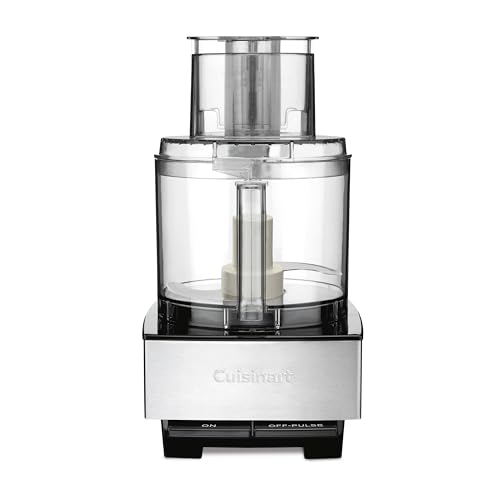
Cuisinart
The most widely owned and recipe-referenced food processor in the category, with 22,000 ratings
- 14-cup polycarbonate bowl with 720-watt motor
- Die-cast metal base for stability under heavy loads
- Extra-large feed tube fits a whole medium potato
- Includes stainless S-blade, slicing disc, and shredding disc
- 3-year limited warranty with decades of parts availability
✓ Pros
- The most widely owned and recipe-referenced food processor in the category, with 22,000 ratings
- 720W motor and 14-cup bowl handle full-size batch cooking that smaller compacts can't
- Extra-large feed tube eliminates most pre-cutting for whole vegetables
- Cuisinart's decades-long parts availability means it stays serviceable long-term
✕ Cons
- At 15+ inches tall with the lid on, it does not fit under most standard 18-inch upper cabinets with room to spare
- Too large for genuinely tight kitchens, the tradeoff this roundup is built around
- No variable speed, pulse and continuous only
- Heaviest and bulkiest unit in this roundup to lift in and out of storage
FAQ
Common questions
Why does my food processor leave large chunks at the bottom and fine powder at the top?
This is a density stratification issue, not a blade problem. During operation, the blade creates a vortex that pushes fine processed particles up toward the lid while coarser particles rema in near the blade. After a long continuous run, the bottom becomes over-processed and the material at the top is large chunks that never reached the blade. Fix: use pulse technique instead of continuous run, pause every 5 to 7 pulses, and scrape down the sides and redistribute the contents with a spatula before continuing. The redistribution step is the critical part, scraping after each pulse series brings the outer and top material back into the blade path for even processing.
My food processor was chopping fine last month. Now it leaves chunks. What changed?
Three most likely causes: (1) The blade is dull, blade dulling is gradual and often not noticed until results degrade noticeably. Test: chop a single onion. If it takes twice as many pulses as it used to for the same result, the blade is dull. (2) The blade is not seated properly, check the seating and reinsert firmly. (3) You are using the continuous run setting more frequently instead of pulse, muscle memory can drift toward holding the run button rather than pulsing. Return to pulse technique and recheck results.
Can I chop raw chicken in a food processor?
Yes, but with specific technique to avoid paste. Ground chicken from a food processor: use cold chicken (not frozen, not at room temperature, 34 to 38 degrees Fahrenheit from the refrigerator), cut into 1-inch cubes, and pulse 8 to 12 times watching between each pulse. Warm or room-temperature chicken produces paste in 3 to 4 pulses because the fat smears rather than cuts. For coarse ground similar to store-bought ground chicken: 8 pulses. For finer ground: 12 to 15 pulses. Never run continuously, continuous processing on raw chicken produces a paste in under 30 seconds. Process in small batches (no more than 1 pound at a time) for even results.
Keep researching
Related guides & comparisons