As an Amazon Associate I earn from qualifying purchases. Picks are based on manufacturer specs, independent reviews and owner reports.
Our top picks
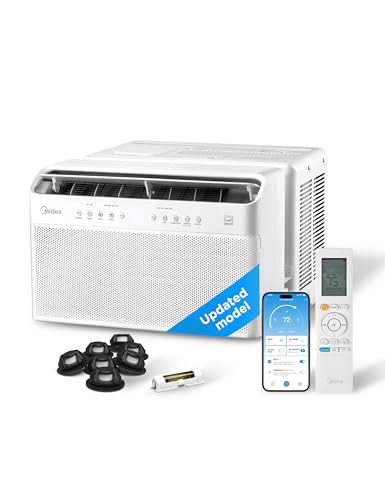
Short on time? Our top recommendation is the Midea 8,000 BTU U-Shaped Smart Inverter Window Air Conditioner.
Compare
At a glance
The traits that separate these picks, side by side.
| # | Product | Best for | Key feature | |
|---|
| 1 | | — | As low as 32 dBA on low fan | Check ↗ |
| 2 | | — | 41 dB rated operation | Check ↗ |
| 3 | | — | 42 dBA rated operation | Check ↗ |
| 4 | | — | Fixed-speed compressor, no published low-noise dB rating | Check ↗ |
In depth
The 4 best, explained
Why each made the cut, where it falls short, and who should buy it.
Midea
And inverter compressor holds a steady low hum instead of the startup burst of a cycling unit. One caveat, installation across the window sash takes longer than a standard slide-in unit.
- As low as 32 dBA on low fan
- Inverter compressor avoids full on/off cycling
- U-shaped frame moves the compressor outside the window
- 8,000 BTU, cools up to 350 sq ft
- 9x quieter than a standard cycling compressor per Midea's published testing
✓ Pros
- 32 dBA is the lowest published rating of any unit in this category
- Inverter compressor holds a steady low hum instead of the startup burst of a cycling unit
- U-shaped frame physically relocates the noisiest component outside the room
- Owner reviews consistently cite it as noticeably quieter than a previous standard unit
✕ Cons
- Installation across the window sash takes longer than a standard slide-in unit
- Midea's 2025 recall and repair program covers some early U-shaped units over a mold-related dra in issue
- Costs more than a comparable fixed-speed unit without inverter technology
GE Profile
And flex-depth frame seals more snugly against the window, reducing rattle noise. One caveat, still audible during initial compressor startup, unlike the Midea's smoother inverter ramp.
- 41 dB rated operation
- 8,300 BTU, cools up to 350 sq ft
- Flex-depth frame for a tighter, less rattly fit
- Sits below the sill rather than filling the window opening
✓ Pros
- 41 dB is genuinely quiet for a unit without an inverter compressor
- Flex-depth frame seals more snugly against the window, reducing rattle noise
- Higher BTU than the LG or Frigidaire at a comparable noise level
- Marketed and independently reported as one of the quieter non-inverter window units
✕ Cons
- Still audible during initial compressor startup, unlike the Midea's smoother inverter ramp
- Priced meaningfully above the LG and Midea
- 41 dB applies to steady-state cooling; fan-only mode is quieter but doesn't dehumidify
Frigidaire
Inverter compressor keeps the 42 dBA rating close to the GE Profile's despite a lower price
- 42 dBA rated operation
- Inverter compressor
- 6-way directional airflow
- 8,000 BTU, cools up to 350 sq ft
✓ Pros
- Inverter compressor keeps the 42 dBA rating close to the GE Profile's despite a lower price
- 6-way vents let you point airflow away from a bed or desk to reduce the sensation of direct fan noise
- PureAir washable filter is simple to maintain, which keeps fan noise from climbing over time
✕ Cons
- 42 dBA is the highest rating among the three quiet-focused units here
- Fewer long-term owner reviews to confirm noise consistency after a full season
- 6-way vent adjustment takes some trial and error to find the quietest airflow angle
LG
Lowest typical price of the units in this list by a meaningful margin
- Fixed-speed compressor, no published low-noise dB rating
- 8,000 BTU, cools up to 340 sq ft
- 3 cooling and 3 fan speeds
- LG ThinQ Wi-Fi app control
✓ Pros
- Lowest typical price of the units in this list by a meaningful margin
- Lowest fan speed is tolerable for a living room, just not ideal for light sleepers
- LG ThinQ app lets you pre-cool the room and skip standing next to it while it's loudest
✕ Cons
- No published low-noise dB rating, and owner reports place it above the three inverter or flex-depth units here
- Fixed-speed compressor cycles fully on and off, which produces a startup burst of noise each cycle
- Not the right choice for a bedroom if quiet is the top priority
How we chose these picks
Every pick below earned its place through documented strengths, verified specifications, consistent praise in reputable reviews, and owner-feedback patterns. We don't sell placements, and we don't invent test scores.
Mistakes buyers often make
- Choosing the cheapest option without checking warranty and support quality.
- Assuming all models work with your existing setup, verify compatibility first.
- Skipping the measurements: returns most often come from fit surprises.
- Chasing the newest release when last year's model does the same job for less.
How to choose: the factors that matter
- Capacity and sizing — Measure your space and your actual use before falling for bigger-is-better. The right size is the one that fits your routine, not the spec sheet's maximum.
- Build quality and materials — Heavier-gauge materials, tight tolerances, and solid joints outlast thin, rattly construction. In reviews, look for longevity comments over first-impression praise.
- Ease of use and setup — Clear instructions, intuitive controls, and minimal assembly separate daily drivers from garage ornaments.
- Maintenance and cleaning — Whatever you buy will need cleaning. Removable, dishwasher-safe, or wipe-clean parts get maintained; fiddly ones get neglected.
- Warranty and support — A multi-year warranty signals the manufacturer expects it to last. Check what's actually covered, motors and frames matter more than accessories.
The bottom line
There's no single 'best' here, only the best match for your situation. Start from your must-have features, then choose the least expensive pick that covers them.
FAQ
Common questions
What are the best quiet window air Conditioners, ranked by decibel rating right now?
Our top pick is the Midea 8,000 BTU U-Shaped Smart Inverter Window Air Conditioner (our top pick), because 32 dBA is the lowest published rating of any unit in this category. The runner-up is the GE Profile ClearView 8,300 BTU Smart Window Air Conditioner AHTT08BC, followed by the Frigidaire 8,000 BTU Smart Inverter Window Air Conditioner FHWW085WE1.
Is the Midea 8,000 BTU U-Shaped Smart Inverter Window Air Conditioner worth it?
For most buyers, yes. It ranks #1 in our quiet window air Conditioners, ranked by decibel rating research, though installation across the window sash takes longer than a standard slide-in unit.
What decibel rating counts as a quiet window air conditioner?
Under 45 dB is considered quiet for a window air conditioner, roughly comparable to a quiet library or a soft conversation. The Midea U-Shaped's 32 dBA low-fan rating and the GE Profile ClearView's 41 dB rating both fall in that range. Standard fixed-speed units without a published low-noise rating typically run 52 to 58 dB on their lowest cooling setting, closer to a running dishwasher.
Why is the Midea U-Shaped quieter than other window air conditioners?
First, its inverter compressor ramps power up and down instead of switching fully on and off, avoiding the loud startup burst of a cycling compressor. Second, the U-shaped frame moves the compressor section outside the window entirely, behind the glass line, rather than sitting inside the room w here a standard unit's compressor noise carries directly into the space.
Does a quiet window air conditioner cool as well as a louder one?
Generally yes, if the BTU rating is comparable. Noise level is mostly a function of compressor type and fan design, not raw cooling power. The Midea 8,000 BTU U-Shaped cools the same 350 sq ft the GE Profile ClearView 8,300 BTU does, just more quietly on its low setting.
Do window air conditioners get louder over time?
Some do, usually from a loose mounting, a dirty filter restricting airflow, or an aging fan motor. A unit installed with a snug fit against the window frame and foam seal strips runs quieter than one with gaps that rattle. Cleaning the filter monthly during the cooling season also prevents the fan from working harder and louder to push air through clogged mesh.
Keep researching
Related guides & comparisons