As an Amazon Associate I earn from qualifying purchases. Picks are based on manufacturer specs, independent reviews and owner reports.
Our top picks
Short on time? Our top recommendation is the Husqvarna 128LD Gas String Trimmer.
Compare
At a glance
The traits that separate these picks, side by side.
In depth
The 6 best, explained
Why each made the cut, where it falls short, and who should buy it.
Husqvarna
And no battery to run down during an extended clearing session. One caveat, requires mixed 2-cycle fuel and periodic carburetor maintenance.
- 28cc 2-cycle gas engine
- 17-inch cutting swath
- Straight shaft with Tap 'n Go head
- Smart Start recoil system
- Accepts click-on brush cutter attachments
✓ Pros
- 28cc engine holds RPM through woody stems and dense brush that stalls smaller trimmers
- No battery to run down during an extended clearing session
- Click-on attachment compatibility allows swapping to a brush cutter blade for the thickest growth
✕ Cons
- Requires mixed 2-cycle fuel and periodic carburetor maintenance
- Heavier and louder than any battery model in this list
- Manual pull start each time versus instant trigger start on electric models
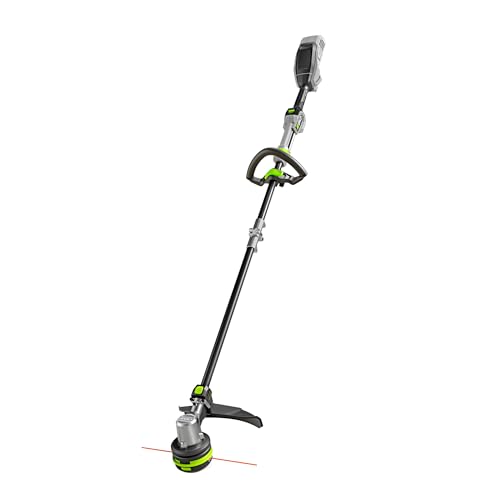
EGO
5Ah included. 0Ah or more) cost extra and are sold separately.
- 15-inch cutting swath, accepts 0.095-inch line
- 56V ARC Lithium battery, 2.5Ah included
- Brushless motor
- Carbon fiber split shaft
- POWERLOAD auto-feed
✓ Pros
- 56V brushless motor holds line speed noticeably better than 40V competitors under thick growth
- Accepts 0.095-inch line, thick enough for woody weeds without stalling
- Runtime on the included 2.5Ah battery is adequate for a typical overgrown-patch session
✕ Cons
- Larger battery packs (5.0Ah or more) cost extra and are sold separately
- Still not a substitute for a brush cutter blade on truly woody brush
- 56V battery doesn't interchange with more common 40V tool lines
Greenworks
Handles moderate weeds and overgrown grass reasonably well for the price
- 12-inch cutting swath
- 40V lithium battery, 2.0Ah included
- Dual line auto-feed
- Variable speed trigger
- 3-year warranty
✓ Pros
- Handles moderate weeds and overgrown grass reasonably well for the price
- Variable speed trigger lets you dial up power only when needed, saving battery
- 3-year warranty is longer than most trimmers at this price point
✕ Cons
- 2.0Ah battery bogs down noticeably faster than 4.0Ah or larger packs in dense material
- 12-inch swath and narrower line struggle with truly woody stems
- Not a realistic substitute for a gas trimmer on genuinely overgrown lots
Worx
Best for light overgrowth only. 0Ah batteries included. One caveat, least motor torque in this list, struggles once growth turns genuinely woody.
- 13-inch dual-exit cutting head
- 40V PowerShare, 2 x 2.0Ah batteries included
- Auto-feed line advance
- Under 5 pounds
- Pivoting head
✓ Pros
- Two batteries extend total runtime across a larger overgrown area
- Light weight reduces fatigue compared with heavier gas trimmers on long clearing sessions
- Dual-exit head keeps decent cutting efficiency for grass and light weeds
✕ Cons
- Least motor torque in this list, struggles once growth turns genuinely woody
- 13-inch swath means more passes across a large overgrown lot
- Not designed for brush-cutter blade attachments
EGO
A 56V cordless trimmer with a telescopic shaft and EGO's PowerLoad automatic line winding.
✓ Pros
- Gas-like power for thick weeds
- PowerLoad winds line automatically
- Telescopic shaft
- Battery and charger included
✕ Cons
- Heavier than 20V trimmers
- EGO battery platform lock-in
- Premium price
EGO
EGO's 16-inch trimmer with POWERLOAD auto-winding and a telescopic carbon fiber shaft.
✓ Pros
- POWERLOAD winds line automatically
- Light carbon fiber telescopic shaft
- Strong 56V power
- 16-inch cutting swath
✕ Cons
- Battery and charger sold separately
- Premium price
- EGO battery platform lock-in
How we chose these picks
Every pick below earned its place through documented strengths, verified specifications, consistent praise in reputable reviews, and owner-feedback patterns. We don't sell placements, and we don't invent test scores.
Mistakes buyers often make
- Choosing the cheapest option without checking warranty and support quality.
- Assuming all models work with your existing setup, verify compatibility first.
- Skipping the measurements: returns most often come from fit surprises.
- Chasing the newest release when last year's model does the same job for less.
How to choose: the factors that matter
- Capacity and sizing — Measure your space and your actual use before falling for bigger-is-better. The right size is the one that fits your routine, not the spec sheet's maximum.
- Build quality and materials — Heavier-gauge materials, tight tolerances, and solid joints outlast thin, rattly construction. In reviews, look for longevity comments over first-impression praise.
- Ease of use and setup — Clear instructions, intuitive controls, and minimal assembly separate daily drivers from garage ornaments.
- Maintenance and cleaning — Whatever you buy will need cleaning. Removable, dishwasher-safe, or wipe-clean parts get maintained; fiddly ones get neglected.
- Warranty and support — A multi-year warranty signals the manufacturer expects it to last. Check what's actually covered, motors and frames matter more than accessories.
The bottom line
There's no single 'best' here, only the best match for your situation. Start from your must-have features, then choose the least expensive pick that covers them.
FAQ
Common questions
What are the best string trimmers for thick weeds and overgrown lots right now?
Our top pick is the Husqvarna 128LD Gas String Trimmer (our top pick), because 28cc engine holds RPM through woody stems and dense brush that stalls smaller trimmers. The runner-up is the EGO Power+ ST1521S 15-Inch String Trimmer, followed by the Greenworks 40V 12-Inch Cordless String Trimmer.
Is the Husqvarna 128LD Gas String Trimmer worth it?
For most buyers, yes. It ranks #1 in our string trimmers for thick weeds and overgrown lots research, though requires mixed 2-cycle fuel and periodic carburetor maintenance.
What matters most for cutting thick weeds, battery voltage or engine size?
For battery trimmers, higher voltage and amp-hour rating matter more than the trimmer's advertised swath width. A 40V or 56V system with a 4.0Ah or larger battery holds RPM under load far better than the same voltage with a smaller 2.0Ah pack. For gas trimmers, engine displacement (measured in cc) is the equivalent spec, and a 28cc engine like the Husqvarna 128LD handles thick brush that stalls smaller 25cc trimmers.
Should I use thicker cutting line for tough weeds?
A 0.095-inch or 0.105-inch line cuts through woody stems and thick weeds far more reliably than the 0.065-inch to 0.080-inch line that comes standard on most consumer trimmers. Thicker line requires more motor torque to sp in at full RPM, which is why underpowered trimmers struggle even with an upgraded line installed.
Can a battery trimmer really replace a gas trimmer for heavy brush?
For most residential overgrown patches, yes, if it's a 56V or high-amp-hour 40V model. For sustained heavy brush clearing on acreage, a gas trimmer like the Husqvarna 128LD or a dedicated brush cutter attachment still has an advantage because it never needs a battery swap and generally tolerates stalling and restarting better than an electric motor under repeated heavy load.
Why does my trimmer bog down or stall in thick grass?
Usually one of three things: the line is too th in for the material, the battery doesn't have enough amp-hours to susta in torque under load, or the head is being pushed through material faster than the motor can clear it. Slowing the sweep speed and letting the tip do the cutting, rather than forcing the whole line through dense growth at once, resolves most bogging issues on an otherwise capable trimmer.
Keep researching
Related guides & comparisons